The Best of All Possible Worlds
If one takes for a starting point that man is a creature living in a natural environment, then our world, our selves, our culture, even our god, are just the product of a long progression of environmental accommodations and ever more advanced physiological constructs. According to this interpretation, we are adapted organisms amidst a milieu of other interconnected adaptations. Everything that we consider good and bad (even good and bad themselves) are merely causally-connected chemical responses to our environment. The desire to write such that others might understand has its source in the gene mutations intended to adapt me as an organism better to you as an organism and better to the world as my environment. If I dislike popcorn or if I think my children are beautiful, then it must be for biologically-relevant reasons. If men find blondes more attractive, then it must be because of reproductive efficiency. If blondes find aggressive men more attractive, it must be because of higher infant survivability. You see, in the modern view, all is for the best in this best of all possible worlds. There can be no disaster within this understanding. No lostness. No fall. No pitching forward into the abyss of our own self-consciousness. In the modern naturalistic view, we have the self and its culture (its environment) perfectly understood. We have pinned man down like a bug in an insect collection. We have named him, classified him, studied him, and dissected him. He is no longer a mystery. We know where he came from and where he is going.
Evidence that Something is Wrong
If humankind is just another creature among many other creatures, then we are certainly the most maladapted. On a typical day, we don’t feel like the mockingbird on the wing or the squirrel digging for nuts, or the deer chewing clover. We don’t feel like an organism in an accommodating environment; we feel like something is wrong. Sometimes only partially and cosmetically wrong and sometimes deeply wrong, but always wrong. And furthermore, the more we seem to know about humans, the less we seem to know about ourselves. It comes as no surprise to us to hear of economists declaring personal bankruptcy, or marriage councilors seeking divorce, or nutritionists struggling with drug addiction, or psychologists going crazy. We perform surgeries on the heart but use the heart to love the wrong person, we retire at sixty but hate retirement even more than we hated work. We are idiot savants, calculating the expansion rate of the universe but stumped by the intractable problem of our own expanding waistlines.
In other words, we are living in the most therapeutic century in the history of the human race, in the most therapeutic country in all the world, and yet are not happy. How could this be? How can an organism live in an environment that is ideally suited to it and yet fail to find it suitable. In the natural world (and we are supposed to be part of the natural world), there is no concept of being engaged, well-fed, well-mated, and safe while also being depressed, frustrated, and bored, and yet we find ourselves in this predicament all the time. And some of the people with the most accommodating environments (movie stars, trust fund kids, rock icons, Russian oligarchs, etc.) seem to make themselves and others the most miserable.
Something must be terribly wrong. Maybe wrong with us (we could be broken animals) or with our environment, but something is wrong. It is profoundly ironic that the same people who argue most adamantly that our consciousness is the result of chance mutations are the first to suggest some intentional, creative treatment for our maladaptation to our world. Nature isn’t supposed to produce maladaptation, or if it does, it’s supposed to fix it by chance, not through our intervention.
Killing Ourselves
Perhaps the most telling symptom of this strangeness is the troubling tendency of human beings, even human beings in accommodating environments, to take their own lives. Many other animals engage in risky behavior. My dog growing up thought it an adrenaline rush to chase automobiles. This I would equate to other strange human activities such as base jumping, free climbing, and the like, but however closely associated with death these activities might be, they are not suicide. About 80 of the 380 odd (I choose this word deliberately) people who have attempted to summit K2 died trying, but all 380 intended to reach the summit and come down alive. Jumping off a cliff with a parachute is crazy, but it is jumping without the chute which is suicide and suicide is often not crazy. The thrill seeker jumps off a cliff with a chute confident he will live but the suicide jumps off a cliff without a chute confident he will die. The latter has a better grasp on reality.
In some cases, animals engage purposely in activities that can only end in death. Salmon, for instance, die soon after struggling upstream to spawn. This kind of death, however, is a byproduct of some other purpose (such as mating, giving birth, protecting the hive, etc). the analogue in the human realm might be the soldier leaping onto the hand grenade to save his comrades or the mother choosing an anguishing and terminal labor to save her unborn child. This too, is far removed from suicide. The purpose of death in these instances is the preservation of life, albeit in others.
In the few cases that come closest to suicide in the animal world, what really appears to be going on is some normal animal instinct going haywire. This may be paralleled in the human world by addictions, eating disorders, and the like. Here the lines become dim, for many of these patterns lead one to desire death. However, The desire to be thin or be high, or to scratch an itch that is not there is not the desire for death even though the failure to attain these things may lead to that desire or cause death inadvertently.
In the animal world, death is never, as far as I know, selected as a bald choice, devoid of other physical benefits to oneself, one’s associates or progeny. We may excuse the suicide when the choice is made in the midst of real adversity or to avoid an equally certain death by some other means. The troubling thing about many human suicides, however, is that the desire for death appears to be the only sign that something is wrong; death is chosen for reasons which the naturalists tell us do not exist.
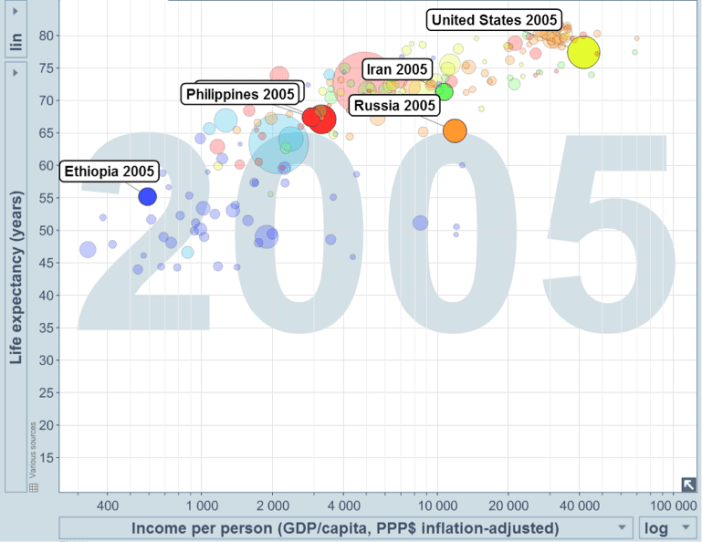
While not a perfect indicator, a few statistics (from gapminder.org) will, I believe, make this picture a little clearer. When we analyze global statistics comparing average income per person with average life expectancy, a clear trend emerges. Those countries with the highest incomes generally have the highest life expectancy. Furthermore, there is a smooth downward gradient in average life expectancy as one moves down the global income brackets. This is to be expected. Richer countries generally have better healthcare, more advanced sanitation systems, more nutritious food and superior emergency response. One must factor in a few outlying factors such as increased obesity among some rich countries, but for the most part, the correlation is solid: Increased income equates to longer life through the improved services that wealth affords.
However, when one compares the same X axis (Income per person) with the average suicide rate per country, all correlation disappears. Suddenly Ethiopia with an average per person income of less than $1,000 per year is equal with the United States with an average income of over $40,000. Russia, with an average income of over $10,000 has a suicide rate that is ten times that of the Philippines with an average yearly income of only about $3,000. The implications are staggering. What this data seem to indicate is that income plays little or no part in our level of contentment. Even with longer life, better food, improved education, expanded opportunity, and access to the finest psychologists (in short, all the things money can buy) we kill ourselves at approximately the same rate.
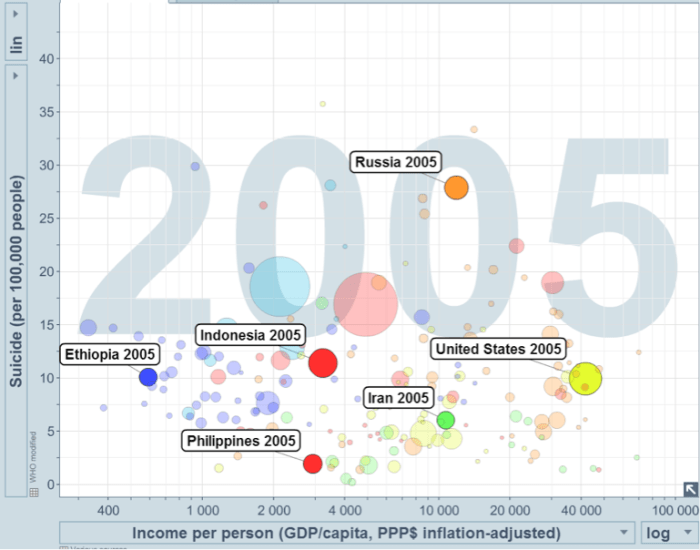
One may justly argue that suicide, while an indicator of contentment and happiness, is not an absolute indicator. It is a good point. One could imagine another chart correlating income per person to reported levels of “happiness”, “life contentment”, “personal satisfaction” or the like that followed the same smooth upward progression with income that life expectancy does. However, these measures, however valid for the sake of study, do not measure what people do but what they say. Since we have not yet invented a machine that can test levels of happiness in the human soul, we can only ask the individual to self-report how he or she feels. It may be only natural to report being happy if one is in the upper income brackets simply because one feels as though he or she has no obvious reason to be sad. It is hard to imagine a movie star sitting down to an interview by his half-acre pool, sipping twenty-year-old scotch and answering that he feels miserable and frustrated. Suicide, on the other hand, is what people do regardless of what they say. If the movie star answers the reporter that he has never been happier, but the next week is found dead from pain killers, we know which data to believe.
A Self in a World
Why might this be? how has it come to pass that in all we have come to understand about humankind, we have somehow failed to understand what makes us content. In an hour of careful study, any one of us could pick up a book and learn enough on the subject of equestrian husbandry to raise reasonably healthy and happy horses, horses which would not frustrate themselves or others and which would certainly not take their own lives. But our own happiness, which we presumably have had a lifetime of experience cultivating, remains an enigma. And how is it that the hardest person to content, among the billions of people in the world, is myself, whom I presumably understand better than anyone or anything else.
The answer has to do, as Walker Percy describes in Lost in the Cosmos (a book I am greatly indebted to), with the way the human self responds to its world in comparison with the way an organism responds to its environment:
Why do people often feel bad in good environments and good in bad environments? Why did Mother Teresa think that affluent Westerners often seemed poorer than the Calcutta poor, the poorest of the poor?
The paradox comes to pass because the impoverishments and enrichments of a self in a world are not necessarily the same as the impoverishments and enrichments of an organism in an environment.
The organism is needy or not needy accordingly as needs are satisfied or not satisfied by its environment.
The self in a world is rich or poor accordingly as it succeeds in identifying its otherwise unspeakable self.
What Percy means by “world” is the sum total of ones consciousness. George Washington is not part of my environment, but he is an important part of my conscious world, helping to inform what kind of person I am. It is these mental associations that form my sense of self. “Liberty”, “revolution”, and “independence” are not part of my environment (I have not touched, tasted, smelled, or seen or heard them), but they are very much a part of my world. Through the ages, these particular elements of consciousness have given millions of people a reason to live, have been the cause for which millions more have willingly died, and doubtless the perceived absence of such elements has caused many more to take their own lives. All of this commotion for a set of attributes that do not exist in our environment but only in the world of our conscious awareness.
When Percy says that the self is rich if it can succeed in identifying itself and poor if it cannot, what he is getting at is that what makes a person’s world (their conscious self) healthy is not his or her environment, but the extent to which the elements of the person’s consciousness form a cohesive and comprehensible whole. This is not to say that the physical world does not matter. Every aspect of the physical world and especially the relationships with other people invade the conscious world of the self. It is simply to say that there is not a one-to-one correlation between what we encounter temporally and how we process that information consciously or spiritually. An animal dies when it’s environment no longer adequately supports it. A person takes her own life when her world no longer makes sense to her.
The Self and the Soul
C.S. Lewis suggested in Miracles that almost the whole of Christian doctrine could be inferred from our embarrassment at bawdy jokes (finding ourselves embarrassing and funny), and our dismay at a dead body (Finding body without consciousness frightening and uncanny). To Chimpanzees nothing is bawdy, shameful, or uncanny. Other animals (at least as far as we can tell) only look out into their environment. We humans, however, are constantly looking in on ourselves, finding ourselves funny, confused, embarrassed, conflicted, and artificial. This last attribute is crucial, for it strikes at the heart of our predicament. As humans, we are constantly observing ourselves from an outside objective viewpoint and concluding that we are somehow not being ourselves. Your dog is always herself, but you are often only playing a part for the audience of your family, friends, or even yourself. Sometimes we sense the roles we play for others are artificially negative: “When I snapped at you, I wasn’t myself. I was so tired…”. Sometimes the roles we play are artificially positive: “I’m so happy you could come. No, you’re not interrupting anything…”. We can probably name someone who thinks we are a better or a different person than we are or thinks that we like their company more than we do. When we consider it closely, it is likely that each person we know has a different idea of who we are and in most of these ideas we can see shades of truth and bits of error. What is most troubling is that we seem unable to successfully arbitrate the dispute. We don’t know any better than others who we are and we sometimes know a lot less.
The reason Lewis says that this absurd state of affairs makes Christianity intelligible is that the central claim of Christianity as to our plight is that the self has been severed from its source of selfhood by the fall, establishing a boundary condition between the self (the soul) and itself (body) that results in endless self-inflicted frustration. To use the language of the scriptures:
So I find it to be a law that when I want to do right, evil lies close at hand. For I delight in the law of God, in my inner being, but I see in my members another law waging war against the law of my mind and making me captive to the law of sin that dwells in my members.
In the beginning, our selves were wrapped up in God. We were, in fact, his children. It was the vine of God’s being that allowed the branches to flourish. Cut off from this source, the self has no other source of grounding.
The Vacuous Soul
All of this is rather esoteric. All we seem to have established is that human’s are complicated and sometimes irrational – hardly a new idea. It seems far-fetched to surmise that grasping the rift between soul and body at the fall of humanity can inform our understanding of modern cultural activities, such as attending a movie or choosing a coffee table, but even our coffee tables betray a certain psychosis, as Percy points out in the same book mentioned previously:
In a recent issue of a home-and-garden magazine, and article listed fifty ways to make a coffee table.
One table was made of an old transom of stained glass supported by an antique brass chandelier cut ingeniously to make the legs.
Another was a cypress stump, waxed and highly polished.
Another was a big spool used for telephone cable set on end.
Another was a lobster trap
Another was a Coca-Cola sign propped on Coke crates.
Another was a stone slab from an old morgue, the brood runnel used as an ash tray.
Another was a hayloft door set on cut-down sawhorses.
Another was the hatch of a sailboat mounted on halves of ships’ wheels.
Another was a cobbler’s bench.
Not a single one was a table designed as such, that is, a horizontal member with four legs.
Question: Why was not a single table designed as such rather than being a non-table doing duty as a table?
(a) Because people have gotten tired of ordinary tables.
(b) Because the fifty non-tables converted to use as tables make good conversation pieces.
(c) Because it is a chance to make use of valuable odds and ends which otherwise would gather dust in the attic.
(d) Because the self in the twentieth century is a voracious nought which expands like the feeding vacuole of an amoeba seeking to nourish and inform its own nothingness by ingesting new objects in the world but, like the vacuole, only succeeding in emptying them out.
Perhaps, as the scientists tell us, we are merely another animal, albeit a strange one. But if this is so, then we must explain why perhaps the strongest and most desperate of our appetites, the desire to know and name our inner selves using everything from coffee tables to symphonies, has apparently no physical source and no physical outlet. How, in a world devoid of the human soul, can one account for so much human energy being wasted simply to inform the metaphysical world of the self? What use have we for the apparitions of truth, beauty, and goodness, liberty and love which lurk inside our minds outside our environment. What use have we for the idea of a metaphysical God who made the soul and offers to knit it back together and back to himself? For that matter, what use have we for science – the method of rational inquiry – or naturalism – the long line of discursive reasoning claiming everything seen and unseen is natural in origin – since these too are apparitions, ideas shared among billions of souls and yet conspicuously absent from the realm of sensation and empirical study? One cannot find a single “therefore” in the natural world but only in the mind of a human.
One would like to go and visit the naturalist in her home and sit down to discuss this strangest of all animals. Perhaps over a cup of coffee she could explain why it is that she has chosen to dress as she does, furnish her home as she has, volunteer at the shelter, spend her time in extended rational inquiry on the most paltry of physical artifacts, and what each of these facets of life mean to her, how they inform her sense of self. One would listen and sip, petting the naturalist’s dog which she has named and which comes when one calls, can sit and roll over, and knows fully and clearly what it is and that coffee tables are for chewing.
 Cultural Orphans